Showing posts with label heavy metal. Show all posts

10/9/18

The Devil, not like other heavy metal bands - supporting the Therion Australian tour


Six years ago I came across an obscure heavy metal band on a Terrorizer magazine compilation.
It was Terrorizer magazine #229 from November 2012. Dani Filth was on the cover promoting Cradle of Filth’s then-new album The Manticore And Other Horrors. Ghaal was back in black and on the scene again with God Seed. A collaboration called Mrityu between Ihsahn and Matt Heafy from Trivium, of all people, was announced (incidentally, it appears that nothing has come from it to date). And an obscure group calling themselves The Devil had a track featured on the accompanying Fear Candy #113 sampler CD.
Despite the criticism that is traditionally heaped onto free samplers, I was a fan of the Fear Candy series. While I acknowledge that the inevitable rule of thumb with the free CD is to discard nine tenths of what you get, those Fear Candy compilations nonetheless got me into some fantastic music. December 2012’s Fear Candy 114, for example, was directly responsible for introducing me to Tengger Cavalry.
The track that got me into The Devil was an intriguing one. Titled Universe, it stood apart from the rest of the compilation due its lack of vocals. And yet, it wasn’t a traditional instrumental track though. Instead, it was made up a multitude of samples detailing UFO sightings and alien conspiracies, overlaid to some reasonably well-produced gothic metal.
The samples were put together in such a way as to construct what a friend termed “a narrative” (an accurate way of putting it, but alas, I’m not a fan of the term) — a story constructed from samples in lieu of vocals.


I was very interested. I was able to find out that The Devil had a self-titled album on Candlelight Records — no small achievement for any heavy metal outfit — but not very little else was known about them. For one thing, all band members summoned the spirit of Ghost by remaining masked and anonymous.
Here’s what I said about The Devil back in 2013:
“This artist is another Terrorizer magazine discovery, and a group about which public knowledge seems to be strangely lacking. What I know comes from a small and somewhat silly magazine interview in which they kind of explained why they remain anonymous and wear masks. Nonetheless, they’re one of those bands that are so mysterious and elusive that their music hasn’t even leaked (yet) into the usual channels.
What is legitimately available for public viewing, however, is a collection of two videos that showcase not only their style but also their awesome multi-media skills.
The first of these videos, Universe, deals with alien conspiracies. The other, Extinction Level Event, is cut up speeches about nuclear war post-WWII. Both make superb use of actual footage and tell a story (because I refuse to use the term “narrative”) put together from various samples. A written description couldn’t do justice to these tracks.
I love them both, so please, watch these videos.”


The Devil: not like other heavy metal bands

I really did dig those tracks. While the audio alone was something I really enjoyed, the multimedia delivery in the form of those videos was something else.
Ever since the heavy metal music video became a medium (fun fact: the first heavy metal music video aired on MTV was by Iron Maiden) it has usually been an accompaniment to a track. Not so with The Devil — here the video was an art form unto itself. It didn’t just accompany the music — the video was the story driving it.
Unsurprisingly, what little information I did find about The Devil included liberal use of the term ‘cinematic’. Nonetheless, this was every bit an obscure outfit. I played those two videos to a few people, to mixed results, and I acknowledged that The Devil would be a group that no one would ever hear of.
I certainly never expected to meet anyone who had heard of them, much less so much as even entertain the thought that I would see them live — and in Australia of all places.
Yet somehow that is precisely what happened.
And here they were.
Pic: Vereance Lucitria

The Devil support the Therion Australian tour

There should be a word for the phenomenon that is a double take resulting from the good-natured disbelief of discovering concrete evidence that a band you love and never expected to see live is visiting your country.
Whatever that term is, it describes how I felt when I saw the promotional flyer announcing the Therion Australian tour.
There it was: Therion. Supported by The Devil.
The only reason that The Devil didn't receive profile shots was because they wear masks.

Oddly enough, the word “devil” is exceedingly popular when it comes to heavy metal band names. At last count, Metal Archives listed 126 results for just [devil] and 22 containing [the devil]. For this reason I was understandably incredulous that it was one and the same The Devil from years back.
“What? Not the The Devil?” was a fairly accurate paraphrasing of my thoughts at the time. “As in, that unbelievably obscure sample-based instrumental heavy metal outfit that released those amazing videos five or so years ago? Surely not?”
Sure, that’s not an entirely accurate paraphrasing of how my brain works (the daily through process is more like, “potato tomato banana oh I’ll just check the weather on my phone and oh I like the look of that band that’s come up on Facebook I’ll have to remember to listen to it later tonight agh where did I put my keys oh wait what was I doing again and what was I going to do on my phone again”).
But it was to be — and on September 12, 2018 I found myself in the crowd at Max Watt’s in Melbourne watching a band that until recently I’d never contemplated would be one I would see live.
And I was mesmerised.

The Devil’s music is divisive

"It's too dark to see their faces."

I loved what I heard and saw. But The Devil’s music is divisive.
Heavy metal music, or rather the people who love heavy metal music, are a morally anarchic bunch. One of the great virtues of heavy metal is the outspokenness of its adherents. If they love something, they’ll figuratively shout it from the rooftops (think Slayer fans whose main word in their vocabulary is SLAYER!). But that goes both ways.
With a group like The Devil, there were detractors who made their displeasure known.
I have spoken extensively in the past about how fortunate we are to live in a city where we are spoilt for choice when it comes to gigs playing hard, dark, nasty and heavy music; how the real enemy of what is popular music played on commercial radio and not that local band who are starting out by playing generic metal because they’re still finding their feet; and how you don’t appreciate the value of any gig playing any music that sounds even remotely like what you love until you live in a town that doesn’t have weekly punk, grind, metal, rock, stoner, noise and industrial shows.
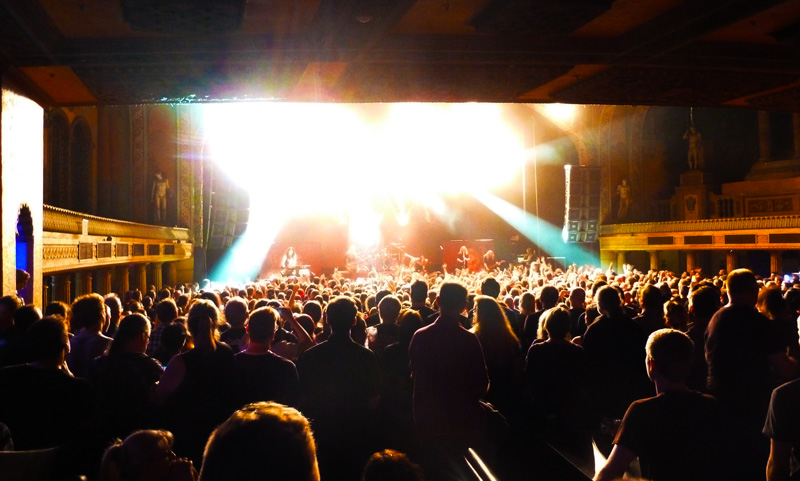
Nevertheless, I’m not other people, so I understand that someone who would not know what to expect could feel underwhelmed from the performance. A major element of what makes The Devil unique is the previously mentioned audio-visual component. In the live environment of Max Watt’s (although in my heart it will always be the Hi-Fi Bar, just like Southern Cross Station will forever be Spencer Street Station) the projector on which much of the performance depended could best be described as ‘decent’. It went down to waist height and was not so much obscured, as interrupted, by moving black-clad masked figures intercepting the perspective of the crowd, looking, as they were, up to the stage at an angle.
I also suspect that the gravitas of various samples may have been lost on some of the crowd due to no other reason but for the original sound quality of those record. For many of the tracks, the narrative, sorry, I mean theme, is based on post-WWII or Cold War-era speeches. While those punters with history nerd credentials would have really gotten into it, the clarity of scratchy recordings from 60 or more years ago may have been lost in the live environment. At least for normal – people who delight in trainspotting Eisenhower’s military industrial complex speech or Truman’s announcement of the use of atomic weapons on Hiroshima during Extinction Level Event would have loved it.
Again, if you weren’t sure what to expect, I can see how someone going to the Therion gig, perhaps expecting bombastic from the support act, could feel that their expectations weren’t being met.
But if you knew what you were in for, or if you love samples (like I do!) you hopefully ‘got it’.
The performance of the track World Of Sorrow was especially poignant. Played over heart-wrenching footage of fires and collapsing buildings from September 11, it plays an on-the-scene TV reporter describing eyewitness accounts of what 9/11 truthers would later cite as the controlled demolition of 7 World Trade Center.
To be clear: September 11 conspiracy theorists, of which Building 7 is one of the most popular, have been repeatedly debunked. I do not subscribe to the views expressed in lyrics (or in this case, samples) of that track, in the same way that I don’t subscribe to lyrical themes found in Slayer lyrics, like Satanic sacrifices or dropping nuclear weapons or getting even through violence and murder. Nonetheless, the combination of samples, masked performance and video was for me, an almost gut-wrenching “wow” moment.
It due to moments like these that I was mesmerised. I loved the performance and I can say with sincerity and appreciation (rather than pretention) that I ‘got’ what The Devil were doing.
Knowing their original music helped, as does the fact that I love industrial music and samples. So too does being a massive history nerd. The live performance by The Devil was, for me personally, a stunning coming together of so many of the things I love about dark and heavy music.
Oh, and that slightly less obscure act going by the name of Therion were up next.
As for the identities of those behind the masks who are The Devil?
Well, I’ve got a conspiracy theory about who it might be… but who would believe me…?

7/29/18

How to easily enjoy a heavy metal gig (when you're not into the bands)

I mentioned in another post how I got to see New Zealand thrash metallers Alien Weaponry on three hours’ notice. It was on a weeknight, during the middle of winter, at a small venue — and to be entirely honest, I’d barely heard of them.
The three or four top tracks of relatively simplistic, mid-tempo groove thrash that I hurriedly streamed for all of 40 seconds said to me that this was a group that under usual circumstances I would not go out of my way to see.
And yet, I had a brilliant night out.

Make your own perspective

There was once a time when I would leave disappointed if the music at a gig failed to grip me. I can’t quite articulate it, so the closest I can come up with might be something akin to a feeling that I’d invested time and energy and money into something that had not impressed me.
But not this time.
I attribute it to something very simple — I merely made a conscious point of setting out to get the most out of the evening.
I have come to believe that what you get out of a heavy metal gig (i.e. how much you enjoy it) has a lot less to do with what you expect, and a lot more to do with how you decide in advance what you will make it out to be.
In short: how you feel about a gig after it’s finished can, if you want, be determined by what you wished it to be before you got there.
Or, it can depend on perspective. And expectations.
So what does that mean?

Great (thrash) expectations

 They were on their way to a European tour and will even plan Wacken Open Air. But some at Metal Archives still don't feel they're metal enough to warrant listing.
Pic: Abby Phillips

The unexpected invite for Alien Weaponry was at Melbourne’s Last Chance Rock & Roll Bar, with tech-metallers Primitive in support.
The Last Chance Rock & Roll Bar is a wonderful, albeit small venue in inner-city Melbourne. It’s the sort of locale that comes to mind when one uses term “cosy”.
As mentioned, I’d never heard anything from the Alien Weaponry discography when I accepted the invite from a friend. Nonetheless, I accepted and pledged to myself that I would have a great time, for the simple reason that I had no expectations. Importantly, no expectations is distinct from low expectations.
Expectation is a funny thing. Of all the complex thoughts and emotions that we understand as human feelings, the thoughts that amount to what we define as expectation arguably have the most power to influence how we felt AFTER doing a Thing — because we created pre-conceived perceptions BEFORE we actually did the Thing.
The nature of expectation is why established artists are guaranteed to always disappoint a minimum proportion of fans, yet if a new artist were to release identical material they would garner praise (yes, that’s a bit metaphysical, but bear with me). Similarly, a show may not “live up to expectations” because of what fans have “come to expect” from a high standard that occurred in the past. Or a talented musician may form a new group but the artist’s “long-awaited” debut is either insufficiently original or too far removed and unrecognisable from what we expected… in other words, what we imagined and hoped it would be.
We then feel disappointed or even angry because we’ve invested emotionally (and probably monetarily) in something and we find the return is not what we desired.
To get a little bit more metaphysical, our evaluation of art and performance risks becoming less about the merits of an individual work of art (for example, a new release) and more about how it compares to our pre-conceived ideals and expectations. Indeed, those expectations are in themselves based entirely on previous works of art, such as an artist’s discography.
Expectation can influences how we feel about almost anything — be it a gig, meeting a new person, a movie or even sporting event — before we’ve even left our home. It is for this very reason that I often explain how unexpected gigs and performances can often be the most memorable.
As mentioned, it was a fantastic show. But not because I was a frothing fan of their music. Alien Weaponry is a band that I would not have considered seeing on the merits of their sound alone, yet I made a point of removing expectations in my mind that would traditionally have told me that a variety of heavy metal that I’m not much into would fail to be enjoyable.
Instead, I consciously saw the very best in the fact that this was a heavy metal gig, at an accessible venue, where just about everyone was thoroughly enjoying themselves, and that there would be many more gigs like it to come.

·         Having said that, if you actually want to know how the gig went, see my Alien Weaponry gig review.

Support came from Melbourne's Primitive.
Pic: Abby Phillips.

As I say behind the above link...

“It made me once more supremely thankful that I live in a city where I am spoilt for choice when it comes to weekly gigs that play music that is hard, fast, nasty and heavy.”


And no, metal Metal Archives currently still won’t list them.

7/28/18

Alien Weaponry + Primitive gig in Melbourne at the Last Chance Rock & Roll Bar


Picture the following. It’s Thursday evening and I’ve got work the next day. It’s dark and cold because it’s the middle of winter. I’m making dinner when a text arrives with an entirely unexpected invitation to see Alien Weaponry, a band I know nothing about. The venue is a small bar which I’ve been to just once, coincidentally also on what turned out to be a quiet week night.
Should I go? Would I have a good time despite not knowing their music? And would heading out on a week night (with sooo many adult responsibilities and all that) be worth the risk?
Alien Weaponry at the Last Chance Rock & Roll Bar.
Pic: Abby Phillips.

How to get the most out of a gig

You’ve read countless gig reviews before, each a blow-by-blow description of what the artists did on stage, what tracks were played or were neglected, whether the sound was on point, how the crowd responded, what those on stage were wearing, and on it goes.
This is not one of those gig reviews.
The Alien Weaponry Melbourne gig was great, but not necessarily for the traditional reasons that you might associate with a gig. To explain, I’ll have digress for a moment.
Quite simply: believe and accept that a brilliant night out has a lot less to do with what you imagine and expect it to be, and a lot more to do with how and what you choose to make of it.
Say what, I hear you utter?
I encourage you to delve further into this idea. I’ll concede that it comes across as an over-thought philosophical approach to something as unassuming as going out and drinking alcohol and enjoying heavy metal music. And yet I feel seeing things a particular way has real merit. That’s because how to make the most out of a heavy metal gig (or any other recreational occasion, I would say) can come down to something as simple as consciously deciding beforehand in your mind how you will actually go about it.
The other reason it was a brilliant night came down to the quality of my friends. Let me tell you a little about them.
Friend 1 was the source of the unexpected invite. She’s a battle-hardened gig veteran (and who incidentally is eight months’ pregnant) who does not hesitate to go to metal shows to see the bands and music that she loves. Friend 1’s partner was ill, hence the spare ticket.
Friend 2 is another gig veteran who can well be described without hyperbole as the life of the party. Friend 2 rarely misses a gig or event — if she does, there’s usually a damn good reason — and when it’s over and finally time to head home you’re left feeling, in large part thanks to Friend 2, that it was definitely worth doing.
Friend 3 is Friend 2’s partner. I’ve known Friend 3 for less than a year but he’s irrevocably now one of squadron, whether he likes or knows it or not. Friend 3 is also a highly talented guitarist and song writer.
Between Friends 1, 2 and 3 are at least 30 years of accumulated friendship. We’ve been through some amazing times together and, as happens with those who are closest to you, we’ve also overcome some darker times. These were the people that would be with me at this unknown show. The venue could have been uninhabited and I’m confident that we still would have had a rocking great time. Fun is what you make of it.

Alien Weaponry sold out the gig


Primitive may be up your cup of tea if you like complex but not unnecessarily flavours.
Pic: Abby Phillips.

Initial concerns about it being a quiet evening were quashed because the Alien Weaponry was in fact sold out. Looking around the venue it was a spectacular array of black band t-shirts. There were rockers, metal heads, old, young. Can you believe it… it was so diverse that some people even had non-black shirts?! On a mid-winter school night no less. That was a great start.
Support Primitive began proceedings with a tight and technical performance. I compensate for the fact that I don’t play an instrument by pointing out that I’m an expert at listening to other people’s music. To my ear, I would describe them as having an almost groove-like vibe while not venturing anywhere near djent or needlessly complex lands. I had no objections, even though it’s not quite my pint of cider, and there were some fantastic ensemble riff moments that got the compact room’s attention.
If you like it a bit technical without the snooty prog-tentiousness, then Primitive may be a Melbourne heavy metal band for you.


Alien Weaponry came on soon after. Mercifully, at a respectably early time for a school night.
“This is our first time in Australia,” announced vocalist Lewis de Jong. “Actually, this is our first time outside of New Zealand,” he added.
Like almost anyone who has something to say about Alien Weaponry in any kind of official capacity, I’m yet another person to hyper-focus on what has already been said numerous times before. Namely, that this is a teenage heavy metal act from New Zealand and that only one of them was able to drive when they got their first tour bus.
Taken out of context, three teenage metal heads playing their first gig outside of their home territory on a Thursday night during winter would seem mildly endearing.
Tonight it was three guys doing just, but on the back of a recent signing to Napalm Records while on their way to a European tour that includes a little-known heavy metal festival called Wacken Open Air.
How many local bands get to do this?
Also, metal kudos for touring with Nervosa, who are as thrash metal as you could want.


What is it that brought out so many people to see Alien Weaponry on a winter weeknight? I would say it was many things, mostly of which have something to do with what makes heavy metal inherently great.
Alien Weaponry play a mid-tempo kind of groovy thrash. It’s not Destruction or Exodus-grade neck-snappingly heavy, nor is it Annihilator or early Megadeth-level complex. It’s fun and, most importantly, has a distinct and brilliant element: the use of Māori haka (look it up if you’ve never heard of a haka).
For the uninformed, think ritualised tribal shouting in another language. Not only was it fantastically original but the result was a vocal style that was neither shouted, growled, screeched or even distorted — yet it was, in every sense of the term, So Metal.
The fact that it was live also made it so much more authentic than if it had been a mere pre-recorded sample. That, and it’s not just occasional featured chanting. Various songs are in native Te Reo language.
As I said, this one element is so incredibly metal.

Everyone loves a Kiwi

Another possible explanation of the good turn-out may have something to do with the nature of New Zealanders. Like Canadians, there is something about Kiwis that somehow seems to make them statistically just that little bit more likeable than just your average person.
Alien Weaponry are from the tiny town of Waipu, in New Zealand’s Far North. They come across as being honest, down-to-earth guys with the right attitude and who are mad for heavy metal (and a bunch of other music too).
To prove the point, and also because you should definitely do yourself a favour, watch this six-minute documentary about them. From what it’s like to be a heavy metal band in a town where everyone knows you, to the benefits of being able to legally drive the tour van, it’s not your ordinary metal doco. Honestly, just watch the damn thing to understand why they are winning hearts and minds.
So they played the Last Chance’s cosy and tightly packed band room. Moshing soon began, its movement being immediately felt and seemingly transferred through bodies in the tight room. Then one mosher went down, crawled to the hallway, and proceeded not to go anywhere. He was clearly in strife and when he managed to remove his boot it looked like he’d seriously damaged his ankle.
The moshing seemed to get more sedate after that. Turns out the poor bloke had broken his ankle in five spots. Even so, after the gig, Alien Weaponry gave him a shout out for insisting he stay and not miss the show.

"Big shoutout to this dude who fucked his ankle up in the mosh last night and insisted on staying to the very end propped against the wall ... that’s some Melbourne dedication right there".

Incidentally, he started a GoFundMe to cover his expected financial difficulties.

All that is great about heavy metal

When it was over, and then, with one encore, it really was all over, I left delighted. In fact, I can say everyone left delighted.
Here, on a school night, at the heart of winter, at a small venue, did a rag tag bunch of misfit punters venture out and have a brilliant time, showing legitimate appreciation and respect to two heavy metal groups, one of which contains members who aren’t event 18. At the time of publication, Alien Weaponry are playing gigs across Europe, including the appearance at Wacken.
To borrow a line from Venom’s 2011 song, Punks’ Not Dead:
“It don’t matter about your age. It’s how you feel. It’s not a phase.”

Their first show in Melbourne... and the first show outside of  New Zealand. Then onto greater things.
Pic: Abby Phillips.

It made me once more supremely thankful that I live in a city where I am spoilt for choice when it comes to weekly gigs that play music that is hard, fast, nasty and heavy.
All these things came together in the form of another reminder of why heavy metal is great — even if Metal Archives currently still refuses to list them.
And it was entirely unexpected.

2/4/17

Korn: Issues - the whine of a generation

You know when you come across a release or a track that you think isn’t quite as bad as everyone had led you to believe — if only it weren’t for that one jarring, inescapable, overpowering element that’s disproportionately responsible for spoiling the whole damn thing?
That’s what Korn is.
Contrary to popular belief, the much-maligned, commercially successful, despised ikons of nu metal, would actually rate as moderately listenable — if only it weren’t for that one overwhelmingly crap quality that persisted in achieving the very opposite. What could it be?

The cover says $2 but I only paid 1$. Winning!


My first encounter with Korn was somewhere in early 1997 (Christ, has it been that long…!) through a mate’s dubbed copy of Korn album #2, Life Is Peachy. From the opening salvo of the intro, it was immediately noticeable. There was that unmistakeable Korn-trademark animalistic / acapella / growling intro that was track 1, Twist. The rest of the album was heavy metal, but not as we know it. It was edgy, atonal, big on the bottom end (or at least as much as you could be on a second or third-generation dub), yet many of the tracks merged into an indistinguishable brown soup of one-ness (although the cover of Ice Cube’s Wicked was kind of memorable).
Life Is Peachy didn’t blow me away and Korn, with few exceptions, did not feature much in my life. Sure, I heard a disproportionately high volume of Korn hits at alt and goth clubs (for which I even purchased a subsequently barely-used Greatest Hits Vol. 1 copy, since I assumed I’d DJ the pants off it); and on at least two occasions I even heard a momentarily smattering of a Korn performance from a great distance at major music festivals while passing between stages. But other than that, I barely paid any attention to Korn for the next 20 years.
Then, not too long ago, I came across a copy of Korn: Issues for the bargainous sum of 1$ at an op shop. Was it worth another try, I wondered?
My preferred method for determining whether something has provided me with sufficient value for money is the “dollar per wear” method. An adage from an older generation that says you successfully justified your consumer spend if you shelled out $20 on something worn 20 times, by this logic my copy of Korn: Issues would be a successful investment even if it failed to elicit any interest after just one full listen.
Issues was Korn’s fourth album, released late 1999. It appeared right after Korn had gotten really big off the back of album #3, Follow The Leader, along with tremendous exposure through the Family Values Tour where they performed with Ice Cube, Orgy, Limp Bizkit and… Rammstein
Hugely anticipated at the time — unless you despised nu metal — Korn: Issues actually contains some decent riffs and quality passages. The problem, unfortunately, is that they're near impossible to appreciate.

Important liner notes.

With Issues, the Korn sound had mellowed, or softened (or sold out), depending on who you ask. They’d focussed more on the song-writing rather than being all atonal and in your face, and had substantial record label support propelling them in this chosen new direction.
Here was a heavy metal group (just accept it) that had started life with a unique and heavy blend of noise rock-inspired heavy metal, with guitar solos substituted by a mixed bag of borrowed hip hop and other genres. By the fourth album, and with commercial success on their heels, the jaggedness had been smoothed out, and the Korn sound had evolved into something closer to a hard rock album rather than the disjointed noise affair of the early days. And all that refinement on Issues would have resulted in a not-entirely-deplorable album if it weren’t for one quality that makes this recording so diabolically difficult to return to: vocalist Johnathan Davis’ incessant whining!

More profound liner notes.

If there’s one rally point that nu metal detractors scorn above all others, it’s the whining, moaning, woe-is-me, vocal style of nu metal singers. Be it Slipknot, Limp Bizkit, Linkin Park, Mushroomhead, Orgy, or whoever, nothing characterises what is most disliked about nu metal more than the whining. But you just wouldn’t understand, right?
On Issues, no amount of production and song-crafting can hide or compensate for the annoyance induced by that vocals whinge — a shame, because it totally detracts from two otherwise decent album qualities.

The four alternative covers were an interesting idea.
Maybe they should have done four alternative mixes too?

Firstly, it obscures quite a few interestingly-produced and relatively ‘minimal’ passages. Like a hip-hop album, where less can be better, Issues has some diverse moments that rely on effects, sound and subtle mood over chugging riffs. While we get small touches of this on the openings to tracks like 4 U and Falling Away From Me, it seems the album is ultimately most concerned with plugging any possible vocal-free leaks with maximum whinging.
Secondly, it does the same for when the opposite occurs — that is, we get the same moaning right just when we’re hoping to get a good riff going.
In other words, Issues is an album that could have been an interesting if not outstanding composite of harsh and light, merging hard moments of head banging mosh power with lighter, thinking person’s CTFD passages, ultimately offering a respectable and matured if inevitably more mellowed and lighter alternative to all that chugga-chugga.
Alas, on this album Korn are obsessed with filling every available moment with Davis’ whining.
I tried with Issues, I really did, but it reminded me of why I never got into Korn. If you still don’t believe me, check out the track It’s Gonna Go Away. With a mere 1:30 duration it’s barely an interlude. When first conceived it may have had the trappings of a good, minimal contemplative type of track, the kind of thing to get you to pause before resuming with the next monster riff — instead, it's literally one and a half minutes of whining. Listen to it for yourself.

At a dollar a play, I got my money’s worth, seven or eight times over.


So that’s why I never got that much into Korn. 

1/11/17

Nightwish at the Forum Theatre | Awesome gigs I should have said something about at the time

The best movies, the best social catch-ups, and commonly the best gigs are often the ones we attend with zero expectations — “zero expectations” here meaning exactly that: no expectations of any sort, as compared to expectations that are low or high.
So it was with precisely zero expectations that I found myself seeing Nightwish at extremely short notice, at Melbourne’s Forum Theatre. This was on January 11, 2016 — exactly one year ago — and in the tradition of unexpected things, I rate it as one of the best ‘unplanned’ (sort of) gigs I’ve ever been to, especially since at the time I didn’t own a single item from the Nightwish discography.
The backstory to this awesome-gig-I-should-have-said-something-about-at-the-time involved lots of uhming and ahing on my part. I had given serious consideration to seeing them with a friend but unfortunately I put off getting a ticket until after discovering it had sold out. Said friend — to whom I cannot emphasise strongly enough how eternally grateful I will forever be — ended up not being able to go at the last moment and kindly provided me with her ticket. The result is best described as that bitter sweet phenomenon where you check out a band whose music you don’t actively follow but you still know who they are, and then you discover how brilliant they are live but it’s bitter sweet because you wished you’d gotten into them sooner.
The classic style of the Forum Theatre in Melbourne was so very appropriate.

I recommend you check out Nightwish live if, like me, you happen to know who Nightwish are but either don’t know their music well or only know their top 40. It will all make sense on the stage, how all that flamboyance and grandiose symphonic style transformed a heavy metal group from a small town in Finland into the country’s biggest music export.
However, almost as epic as the degree of commercial success of Nightwish is the level of drama and controversy. Founded in 1996, Nightwish (very publicly) fired their first two vocalists under very acrimonious (and again, very public) circumstances. But that didn’t detract from the superbness of this show.
From the moment they opened with Shudder Before The Beautiful from then-still-most-recent-Nightwish-album Endless Forms Most Beautiful it was clear that this show would be quite something. Nightwish singer 3.0 Floor Jansen’s soaring voice is out of this world-grade brilliant, and the general sound quality — something you value highly when you’ve been to enough gigs with terrible sound — was excellent.
There were further surprises for a first-timer like me. I discovered that bassist Marco Hietala has an incredible voice, as heard in his backup vocals and one or two tracks on which he sang lead. Marco is obviously not the primary singer but he is, to quote a friend, “a proper power metal vocalist with his own other band”.
Floor Jansen's voice is just killer.

The most pleasing discovery would have to be Uilleann pipes man Troy Donockley, now a permanent member. The stand-out was the epically magnificent pipe solo on the track I Want My Tears Back, because there's something diabolically catchy about pipes, let alone Uilleann pipes, played by one of the very best.
Less impressive was the fact that Floor Jansen seemed to disappear through the back of the stage every five minutes. Whether this was because she was required to fix her makeup, wipe off the sweat, or ensure that main-man Tuomas Holopainen wasn’t getting upstaged by her presence, I will never know.
Indeed, Nightwish detractors like to point out that Nightwish — or rather Tuomas Holopainen, being the primary composer — disappeared up Nightwish’s ass some years ago. To paraphrase the same friend from before, Nightwish used to be a ‘proper’ metal band with distinct riffs and solos, but are now more concerned with drowning everything except for vocals in layers of studio production.
I don’t full agree with this notion but I can tell you that this gig led directly to me buying my first Nightwish album, Imaginaerum — which I found very disappointing.
Yes, I get that it’s an indulgent concept album, but save for three chorus-soaring epic singalongs — Storytime, the previously mentioned I Want My Tears Back, and giant concert closer Last Ride Of The Day — I found Imaginaerum didn’t stand up to long-term listening. But for those three brilliant corkers, I found Imaginaerum sooo dull, none more so than on the 13:38-long Song For Myself.


Guess which ones are the best.

However, none of this came through during the gig. Yeah, there were a few moments that the hard-and-fast heavy metal lover in me found a bit snoozey, but otherwise it was a superb live show, and anyone who wasn’t smiling their arses off by the end was either comatose or deceased.
Nightwish are a first-rate live act and this came through as clearly as possible at this sold out Australian show.
The sound at the Forum was excellent too.

As I said, this gig was approached with zero expectations, and it turned out to be great. I will definitely try to catch them live again, although the degree of expectation this time will obviously be different. Knowing what I experienced, those high expectations will hopefully be well-founded. Just as long as Tuomas and the rest of Nightwish keep their egos in check (or aren’t allegedly taken out of context when purportedly dissing other bands). Then there those comments about Floor Jansen being “the last” Nightwish vocalist.

Seeing as their track record with retaining vocalists ain’t that great, let’s hope it doesn’t come to that.

12/22/16

You haven’t lived until you see a Manowar tribute band at a dodgy venue with a cockroach problem

A Manowar cover band – yes, that got your attention – playing through a malfunctioning sound system at a small dive bar with an alleged cockroach problem.
It wasn’t quite the strangest gig I’d ever been to, but it certainly was peculiar ones. For one thing, did someone say Manowar cover band?
The Triumph Of Steel, Melbourne, November 5, 2016 @ Whole Lotta Love.

Yes. They’re called The Triumph Of Steel and you should definitely see them live.
Consider how much Manowar are the gigantic anti-hipster hipsters of heavy metal. More metal than any metal that ever metalled in Metalville on plant Metal, Manowar are so densely absorbed into everything Manowar — with everything they do being so jaw-droppingly, cringe-inducingly, they-can’t-be serious-grade uncool — that to be serious about liking Manowar seriously is inherently cool.
Don’t get me wrong, I love Manowar, particularly the first half a dozen or so albums in the Manowar discography. It’s just that, if Manowar managed to convey even the tiniest sliver of tongue-in-cheek irony, people would probably be less inclined to believe that Manowar had long, long, long since disappeared up their own arses. Alas, non-seriousness with Manowar there just ain’t. Disregarding the unbelievably homo-erotic band promo shots from their earlier era, the true silliness of what Manowar became is evident in, for example, in printing all lyrics for an entire album in genuinely illegible faux-runes, thereby defeating the purpose of providing lyrics in the first place. Or maybe it started with the line of Manowar Warrior Shield condoms?
From their sixth or so album onwards, Manowar didn’t just jump the shark – they swam some laps together, hung out at the bar afterwards and became best of friends. Consequently, as far as the Manowar of today goes, the Manowar vision of what constitutes heavy metal is single-mindedly inflexible.
Which of course means that The Triumph Of Steel aren’t just any old cover band. They’re a Manowar cover band – and faithfully mimicking a band that morphed into a parody of itself takes a very special kind of wheel on fire.
Thankfully, the Triumph Of Steel were wonderful when I saw them on November 5, 2016 at a little bar called Whole Lotta Love. They put on a good show and did not lack dedication, a feat that is even more notable considering their technical and pest-related (more on this shortly) challenges.
Vocalist Igor’s melodic voice was outstanding. Indeed, merely being a good power-melodic vocalist isn’t easy, but only the leatheriest chaps can properly pay direct homage to Manowar vocalist Eric Adams takes. Filtered through his rich accent, it would have made for a captivating show — were it not for the poor old malfunctioning PA.
"Faaahiiighting, faaahiiighting, fighting the world!"

Through absolutely no fault of their own (I was informed by what I was assured was a reliable source) the house PA was just not playing ball. While the guitar came through ok, the vocals jumped between excessive quietness or cut in and out, possibly because of a loose connection. It wasn’t too bad from the bar and beyond, but it was excruciating at the front of the small stage where I wanted to stand. My gig compadre pointed out that the band were in all likelihood oblivious to what was going out the front. This was probably a good thing as it would have been a shame to see them thrown by somethign that wasn't their doing.
Towards the end of the set, enough beer had been consumed, or perhaps the track selection struck the right power chord (or perhaps a combination of both) that the men at the front (and they were all men) of the stage really got into it. Fighting The World material, it seems, holds a special place for Melbourne heavy metal lovers.
And so The Triumph Of Steel finished their set, to an audience that was small but sincerely appreciative, for the power and the glory and the singalong choruses. When it comes to heavy metal, Manowar are one-of-a-kind, and this Manowar cover band played their role faithfully.
Gig compadre and I stayed back for a drink or two where we had a bit of a chat to guitarist David, who seemed like a nice chap. Last drinks were called and then… cockroaches.
Or to be perfectly honest – one big cockroach, casually making its way across the dance floor. I pointed this out to the reliable source mentioned at the start of this story, who responded by saying that the venue had, apparently, quite recently enlisted the service of a pest controller — but then the joke was that said professional must have missed a spot.

A week or so after the gig I found myself hanging out with a friend, where I casually mentioned this peculiar evening. She mentioned how she’d once ended up there with the intention of enjoying a quiet drink. It was an uneventful night, said the friend (who — and this will become relevant in a moment — is what you’d call small-statured), until she went to the bar and noticed how she rather stood out from the other patrons. She was dwarfed by the great many enormous people all throughout the room who, it turns out, were there to enjoy the dedicated BBW night that was regularly held at the venue.

What a strange thing it is. But actually, it’s just another great night out in Melbourne. I love live music and events in this city and I wouldn’t swap it for anything.

9/30/16

Denouncement Pyre launch Black Sun Unbound at the Bendigo Hotel - and I didn't feel too old

Does heavy metal truly flow in your blood? If the answer is yes then I choose to believe that the fire never leaves you, no matter your age. What changes when you’re at a gig is what I like to think of as a case of things getting more efficient — that raging open wood blaze that burnt so brightly and unpredictably is now one of those modern, efficient, possibly quieter but definitely more reliable gas heaters.

There comes a point — usually in what is considered the ‘middle’ part of life — where the wild expectations of seeing a live band are tempered by the begrudging realisation that this dying meatbag body you inhabit isn’t quite as sturdy as it used to be.
I’ve been warned many times not to get old. Especially on Friday nights, when all you can think of at the end of your five-day 9-5 working stiff routine is how nice it would be to block out reality by inching just a bit closer to finally Netflixing all 178 episodes of Star Trek: The Next Generation.
Yet here I was, on a Friday night, still getting older, but defiantly getting ready for a gig, because I love heavy metal and I love this art form called extreme music.
The occasions was Melbourne’s Denouncement Pyre, who were launching their recently released new album, Black Sun Unbound. The location was that reliable pedestal of a venue that will put on extreme music where other venues won’t: the Bendigo Hotel. I’ve written about Denouncement Pyre before because they put on a great show, and also because I strongly suspect they’re close to being (or might actually be) the band I’ve seen live more than any other. Indeed, I’ve seen Iron Maiden seven times and The Night Terrors on a comparable number of occasions, but I can’t recall the number of Denouncement Pyre live performances I’ve accumulated.

Denouncement Pyre. Pic: Ashleigh Duncan.

As you get older, you tend to get more chilled when it comes to those things that years ago might have caused some existential anxiety. Or, if a younger me was somehow able to address an older me, I might find it amusing to say that you simply have less f***s to give.
On the other hand, you also find yourself in a situation where you need to duck out because you could really do with a coffee before the main act takes onto the stage.
But more on that later.
Denouncement Pyre are one of those bands who seem to get just that little bit better each time. Despite the fact that I cannot play a musical instrument (in my defence, I’m exceptionally good at listening to music), it’s clear that they have ammunition-carrier-loads of technical proficiency and the dedication to drive it. The gig was also an occasion to see Tasmania’s Ruins, who I didn’t know much about but sounded promising.
But back to getting old…
Does heavy metal truly flow in your blood? If the answer is yes then I choose to believe that the fire never leaves you, no matter your age. What changes when you’re at a gig is what I like to think of as a case of things getting more efficient — that raging open wood blaze that burnt so brightly and unpredictably is now one of those modern, efficient, possibly quieter but definitely more reliable gas heaters. Yes, a gas fire is nowhere near as awesome as a raging wood fire, but they’re equally effective and the end result is just the same. And besides, Victorian smoking regulations mean it’s way harder to come home with a jacket reeking of cigarette smoke.
Subjecting your body to lethal doses of beer like you did back in the day would now also mean writing off most of the next day (and apparently, once you add another decade, there’s also all of Sunday to take off). So you tend to get a bit more selective and try to make the most of it.
Assuming you have a stable income, you also worry less about the getting to and from. Back in my day, when you tied an onion to your belt, which was the style at the time, you also had to think about funds. Having less of them generally meant choosing between getting home and getting one last drink. While meeting new and interesting people on the NightRider home did make for memorable encounters, the novelty soon wore off.
It’s a cruel twist of fate, isn’t it? That in order to have the freedom to not worry about being strictly responsible you need to live your life somewhat strictly and responsibly so as to not have to worry about losing all that freedom.
And finally, one last benefit, at least in my situation, is that, generally speaking, there’s hopefully less worry about your place in the world. Figuring out this thing we call identity for many people on both sides of their twenties is a work in progress, but add another 10 years and you’re less likely to carry on in a way that doesn’t resemble the real you.
Of course, I’d be lying if I said I didn’t sometimes get fleeting moments of anxiety — and then I remember that I’m here to see a talented band play a variety of music that I love and that I’m privileged to live in a city where this is a regular occurrence.

Quite a line-up.

To wit, the pre-gig grown-up-grade (so not McDonald’s) dinner that my gig-going counterpart and I began with was at the magnificent Mrs Parma’s. Apart from the innuenduous title, they have a first-rate albeit-higher-than-average-priced selection of craft beers and the Mexican parma is simply superb. Beware though, for if you’re not accustomed to chilies, you may end up paying for it the next morning (what was that about getting old)?
Upon arriving at The Bendigo Hotel I sadly missed the power electronics violation from RuiNation. Though power electronics are typically not my first choice of beverage (I won’t knock it back, it just doesn’t feature prominently in my music collection), I do love the fact that a performance of confrontingly atonal noise music like this opens up a metal gig.
I did, however, catch the tail end of Hordes Of The Black Cross, who finished with a rather savage black thrash number. Perhaps it happened to be one of their best tracks, what with it being a done thing in live music to finish with the good stuff. Or perhaps it was something else? Whatever it was, the sound emanating from the stage was excellent. I’ve been to several Bendigo Hotel shows and I’ve occasionally noticed a muddy character to the audio — but not this time. It might have had something to do with new sound insulation behind the stage, or it might have been due to something else, but either way, every band I saw that night sounded sharp.
This quality helped bring out so much of the fine detail for Ruins. From Tasmania, they play an interesting, very non-linear (non verse-chorus-verse) kind of second wave-ish death-black metal, on the mid-tempo spectrum, more about murk and mire than freezing blasts.
That made perfect sense, right?
One unusual thing – and I say unusual in the context of the three-standard-deviations-away-from-normality that is playing live black and death metal – was Ruins vocalist Alex Pope. On this bill there was no shortage of bullet belts, dark and satanic imagery, splotches of corpse paint – death and black metal tropes, if you like. Yet on this night he had none of those. No corpse paint, bullet belts (that I could see), war chains, gas masks — there was a band shirt though.
In no way am I diminishing the inherent value that all these things add to a metal show — I love it when what you see in a performance matches what you hear — but nonetheless, kudos to him for delivering the same vocal savagery, minus the optional accoutrements.
It seemed to me like a very honest performance, as if I was witnessing the spirit of Aussie pub rock — albeit a damned spirit from the last pub in the abyss. It was a good show, incidentally, and (I think it was the) closing track Suicidal Pulse sounded incredible.
After Ruins finished it was time for me and my gig counterpart’s running joke — namely, how we could really do with a little rest between bands. The running joke started earlier this year when we caught the train into town for Iron Maiden and ended up on quite a detour to acquire a much-needed coffee pep up.
And so on this occasion coffee called us again. Alas, no traditional coffee vendors were open at that late hour in the sort of dodgy end of Collingwood. We did pass one place called Everyday Coffee but we were informed that they only sold fancy cocktails. As an aside, I’m proud of my restraint in not pointing out the name of the venue to the staff member bearing the disappointing news, and therefore not contributing to shaping that individual's poor worldview of the hospitality industry.
Ultimately we settled on petrol station-grade coffee. It was dirt cheap and not too far off from dirt tasting either, but we weren’t consuming it for the flavour and that was fine by us.
After we returned it was time to see Denouncement Pyre.

Denouncement Pyre at the Bendigo Hotel.

Wicked bass. Pic: Ashleigh Duncan. Terrible Photoshop editing: me.

As mentioned, they seem to get a little bit better with each show and each new release. The recognition is growing, with that still-recent performance at Maryland Deathfest 2016 apparently garnering some deserving attention.
It turned out to be an excellent show, but you knew I was going to say that. Although terms like tight, imposing and commanding come to mind, the truth is that it’s difficult to sensibly describe in words what music sounds like — best you go hear and see it for yourself. They played some new tunes from Black Sun Unbound and generally owned the stage — a representative example of what I’ve heard overseas people use the term 'scene' when referring to Aussie blackened thrash.
After the gig I spoke very briefly to Ruins’ Alex Pope over the merch table. I asked for a recommendation on which album from the Ruins discography would be a good start (the table had three to choose from) and he gave me a deal on three albums — and even threw in a patch, which was very nice of him. He also thanked me, very sincerely, “for your support”.
And at that, it was almost time to go home and go to bed.
Well almost.
As the main room was emptying I talked to someone who, unbelievably, wasn’t wearing a black band shirt and didn’t listen to all that much extreme music. We discussed cats and tractors — and let me tell you this: Massey Ferguson is the real deal folks.
It was one of the most interesting conversations I’d had all week. Not to depreciate the value of the other conversations that night or that week, but not just cats AND but ALSO agricultural machinery at a metal gig is a rare combination. Regrettably, it was over all too soon and us oldies had to go home and shuffle into bed in preparation for all those forthcoming adulty responsibilities.
As I made my way home in the back of a cab I figured it had been a very decent night. The gig was well-attended and supported. I had some expensive-ish craft beer over a Mexican parma as well as some normal-priced generic beer, and a dirt-cheap-priced coffee too. I was reminded that this art form called extreme music is alive, well, and routinely commanding a great turnout.
I saw some good music. I met some interesting people. It was an affirmation of the great things about heavy metal. But I still thought the bit about cats and tractors was a memorable highlight.

As I said, you look at things a bit differently as you get older.

1/24/16

My $180 shopping spree at Heartland Records

I’ve mentioned numerous times how Heartland Records in Melbourne, Australia, is my absolute favourite record store. So much so that once a year when the festive season rolls by, when asked by relatives what gift I would like, I imply that a Heartland Records gift vouchers wouldn’t be sneezed at.
Consequently, it’s around this time every year that I go on a Heartland Records shopping spree and end up with some killer new music. Here’s this year’s haul.

My annual pilgrimage to Heartland Records.

This is what I ask for every Christmas.

Bathory — Bathory

First cab off the rank: the first album in the Bathory discography and arguably one of the first true black metal albums.
I decided to buy this after I recently renewed my interest in Under The Sign Of the Black Mark (Bathory album number three) after owning it for several years. With this I’m expecting primitive, low-fi, Venom-inspired proto-evil noise. I don’t expect it to have aged well but I do hope to get a deeper understanding of what it must have been like to hear this for the first time all the way back in 1984 — that’s more than 30 years ago, in case that wasn’t painfully obvious.


Bathory — The Return…

Second cab off the rank: the second album in the Bathory discography. I’m familiar with just one track from this album, a cover version of the title track from the Marduk – Glorification EP. I’m expecting more evil low-fi noise, but of an improved calibre compared to its predecessor. Again, I’m going to try and imagine what it must have been like to be bludgeoned in the face for the first time with such an infernal racket when this was released in 1985.


Bathory — Blood Fire Death

When the discussion arises, I like to point out that Quorthon (Bathory main-man, guitarist, song-writer, etc.) is one of the very few people who can take partial or full credit (the jury is still deliberating) for creating not one, but two styles of heavy metal: black metal, which originated in the first three Bathory albums, two of which are listed above; and Viking metal (more of a term, yes, but still a thing), which has been agreed on as starting with the 1990 Hammerheart album.
I’m a fan of the melody, epicness (a heavy metal album entirely about Vikings, which gave rise to a thing called Viking metal, is as epic as it gets) and solid song-writing on the Hammerheart album. Blood Death Fire was its predecessor and was an in-between album. It bridged the rawness and downright evil vibe of the first three Bathory albums, and led to the more melodic Viking sound / concept / vibe of the Hammerheart album.


Bathory shirt

I don’t own a Bathory t-shirt, so this was an opportunity to correct that. What's that, wearing a Bathory shirt but not being intimately familiar with all Bathory albums makes me a poser? So far I’ve probably spent more money supporting this band than most people under 25.


Motörhead — Rock ‘N’ Roll

A couple of years ago I made a conscientious effort to appreciate more Motörhead, so I figured a good starting point was a neat box set containing the first six full-length albums in the Motörhead discography. I’m glad I did that because not only did I love these classic Motörhead albums, I’d also grown to appreciate and understand enough of Lemmy and Motörhead to be able to genuinely consider myself something of a fan before he died.
At the start of the year, I could genuinely say I'd gotten into Motörhead, yet there were something like 14 more Motörhead albums out there that I still needed to get to know. After Lemmy’s recent death, I made the point of getting to know more of his music, which is how I picked up this and another Motörhead album (below).
Coincidentally, I had a copy of Rock ‘N’ Roll on multi-generation dubbed cassette tape when I was all of 11 years old. I can’t recall what happened to my copy but I do recall when listening to it that it didn’t leave a lasting impression. More than 20 years later, I’m really loving Rock ‘N’ Roll, having fast-tracked this album to be listened to first off the pile.


Motörhead — March Ör Die

March Ör Die is the second of two newly acquired Motörhead albums. Apparently long-time Motörhead album cover artist Joe Petagno was incredibly unhappy with this one.
I haven’t listened to this one yet but I’m tipping it’ll be a great album. It’s not merely Motörhead, but it’s Motörhead doing the track Hellraiser, among other things. If you haven’t seen it, do make an effort to watch the video. As I said previously, no matter how awesome you think you are, you’ll never be Lemmy-winning-at-cards-against-the-Cenobite-Hellraiser-himself-awesome.


Various — Extreme Sündenfall 10

The Germans put out some superb EBM / industrial / goth compilations. Compilations like the Gothic Compilation, which hit at least 61 volumes, come to mind, as does the Extreme series (Extreme Sündenfall, Extreme Clubhits, Extreme Traumfänger, Extreme Störfrequenz, Extreme Lustlieder, and more).
This one appears to be one half of the 2010 edition. Like every Extreme Sündenfall volume, it’s got cringe-inducing cover art (every cover has a different nekkid lady or two for some reason), but that’s balanced out by what will hopefully be some decent music and new artists worth investigating.
Those wacky Germans. I guess a bit of flesh helps them keep the scene alive.


Marilyn Manson — The Beautiful People

In 1996, shows like MTV (when MTV still played music videos) and Rage began airing a disturbing music video from a then relatively unknown American artist calling himself Marilyn Manson.
At the time, Nine Inch Nails was a big deal, two years after the release of 1994’s The Downward Spiral. By extension, industrial metal was attempting to break into the mainstream. The much maligned creation called nu-metal was also busily being the bane of ‘serious’ metal heads who thought whining and wearing dreadlocks was an affront to heavy metal. It’s also worth noting that Kurt Cobain had been dead for two years and the grunge phenomenon was petering out.
Into this environment arrived former music journalist Marilyn Manson with his hit single, The Beautiful People. Produced by both Trent Reznor (Nine Inch Nails) and Dave Ogilvie (Skinny Puppy), its unmistakeable guitar riff to this day hangs like a chain around Manson’s neck, forever the Marilyn Manson signature track.
The shocking-rock imagery and theatrics, the heavy but accessible metal / hard rock sound, and extremely savvy publicity machine (Brian Warner, before he took the stage name Marilyn Manson, was a music journalist with an uncannily sharp nose for how rockstardom worked) ensured Marilyn Manson was constantly in the headlines. And with that, he managed to get himself successfully lapped up by an entire new alternative music generation.
I was never much of a Manson fan to be honest. I don’t own a copy of Antichrist Superstar, from which The Beautiful People is taken, probably because I recall borrowing a mate’s CD copy not long after it came out and not thinking very much of it.
The single that is The Beautiful People represents a throwback to a time when three-track physical releases, put out on the cheap in cardboard sleeves like this one, were a viable way for record labels and distributors to promote themselves, and for pre-streaming / downloads / torrents / YouTube / etc. kids to get their hands on new music.
Those were the days. A widespread alternative music culture was alive and kicking all over Australia — embodied by the tremendous variety and credibility that was The Big Day Out, when it was a genuinely cool alternative festival.
1996 was a good time for a kid to be into alternative music.


Ministry — Twitch

Ministry are a group that its devotees rant and rage over with all their heart, and which I personally took a very long time to ‘get’.
I never actively disliked Ministry. It’s just that they had a sound that kind of didn’t do much for me. The combination of Al Jourgensen’s raspy vocals and the heavily processed, kind of second-fiddle guitar tone just didn’t excite me.
Then one day I had a Ministry breakthrough moment after buying The Last Sucker album, incidentally as part of a previous Heartland Records stash. The first and closing tracks from The Last Sucker — they’re very different but both stompingly good tunes — got me interested in Ministry again, and from there I ‘reverse engineered’ things. I re-discovered classic Ministry albums that I’d previously purchased on reputation alone and from there grew to appreciate all this great music from the Ministry discography that had previously not done much for me.
That’s one of the reasons why I collect physical media. I feel that a predominantly digital-format collection is too ephemeral for my needs. You might not love or appreciate something at the time but you may grow to love and appreciate it later in life.
With digital media it is too easy to forget, which means it is too easily deleted. A physical collection, by virtue of its physical presence, forces you to revisit and re-evaluate. Indeed, I can’t recall the number of times I have bought a release, not thought much of it, shelved it temporarily, and then re-discovered and genuinely re-appreciated it at a later time.
Ministry’s Twitch album is (apparently) a predominantly electronic album. I don’t know how I’ll feel about it compared to later-era, guitar-based Ministry, given that Ministry for me wasn’t love at first sight. And what if it doesn’t grip me first time?
Then I'll shelve it for now and stumble across it at a later time.


Ministry — The Land Of Rape And Honey

Ministry album number three and also the album released immediately after Twitch (above). It’s Ministry’s first attempt to get serious with industrial metal by way of guitars. As with Twitch, I’m not sure what to expect on this one. It’s from Ministry’s early days and is bound to sound remarkably different to later releases.
As for the appalling name… apparently it’s taken from a slogan for a real, actual, genuine location somewhere in America that specialised in rapeseed and other agricultural products. Trust Al Jourgensen to come up with that.


Various — Celebrant 2003 Der Mittelalterliche Klangkörper Zum Wave-Gotik-Treffen

I'll buy you a cookie if you're a non-German speaker and you manage to pronounce "Der Mittelalterliche Klangkörper Zum Wave-Gotik-Treffen" that without inadvertently spitting on yourself.
There are few places in the world where a full-length compilation of artists making Medieval and Medieval-inspired music makes financial sense; there are even fewer places that will host an entire stage playing this style of music at a major international festival.
Germany is one of those very few places. Or possibly the only place.
Wave-Gotik-Treffen is the famous international ‘black scene’ (as the Germans call it) festival where once a year every incoming flight to Leipzig is transformed into Flight Number 666 as thousands of black-clad-wearing freaks invest the city to catch 150 or more bands playing ‘dark’ music, from noise to industrial to goth to — you guessed it — medieval-inspired.
“Der Mittelalteriche Klangkörper” roughly translates as “The Medieval orchestra.”
There are 15 tracks on this compilation from the 2003 “celebration” of the festival. Other than that I have no idea what to expect. I recognise one group here: Corvus Corax, a group associated with Tanzwut, who in my view play the greatest bagpipe / Neue Deutsche Härte rendition of the Beethoven’s Ode To Joy ever recorded.
Medieval-inspired German Medieval music. What’s not to like?


Metallica — Death Magnetic

A few years back I saw this at JB HiFi for the princely sum of $14. At the time I felt that was too much, not because it’s fashionable to trash everything Metallica has touched in the last 20 years (which is laughably easy to do) but because I’d heard so many terrible reports about the dreadful audio compression that Metallica, for all their financial power and production nous, neglected to get right on this album.
Death Magnetic is the album that, apparently, has an unbearably messed up dynamic range. Fans hated it because it could have been a decent album, if only it didn’t sound like arse. Famously, an earlier release of this album's music — released for a video game, no less — didn't get the final dynamic range-ruining, ultra-compression treatment. That is, the video game version sounded far superior.
Nonetheless, I’ve heard worse albums — albeit not from the world’ most successful and best-resourced heavy metal band. For this reason, I felt Death Magnetic shouldn’t be entirely discounted, so I decided to give it a go when I saw it at Heartland Records for the equivalent of $8.


Various — Maschinenfest 2002

Maschinenfest is an annual festival in Germany (of course — where else?) focusing on industrial, noise, experimental and other extreme electronic music.
I’ve got some great stories about Maschinenfest after I went there with a mate in 2013. It was my first ever European festival and the gig (and the trip there and back) was one of my memorable.
I totally had an intriguing, fascinating, thigh-slappingly funny account all written down and ready to share. Then some lowlife burgled our house and stole my stuff. I lost my backup hard drive with a whole bunch of treasured holiday pics.
So that was a bit discouraging.
One day I’ll retell the story of our adventure to Germany and Maschinenfest 2013.
I believe the Maschinenfest organisers release an annual compilation of featured artists. The version here is the 2002 edition, released 10 years before the event I attended, when music (and by music I mean noise) creation technology was less sophisticated. I’ll be interested to see how it stacks up to the 2013 edition, which I vaguely recall I have lying around somewhere.


Imminent Starvation — Nord

Talking of noise, I know of at least one person who claims that hearing this album changed their perspective on industrial music. I don’t know much about Olivier Moreau, the artist behind Imminent Starvation (later renamed just Imminent) although I own his triple seven-inch ‘cowboy-noise’ collaboration with Synapscape. It’s an odd release, being a collaboration of two artists playing rhythmic noise (do the kids still call it powernoise?) and twangy cowboy guitar. For real.
I get the impression that Nord was something of a watershed movement for a lot of people. The individual mentioned above, for example, claimed he lost interest in ‘regular’ EBM after hearing Nord. I’ve heard comparable views, though not quite as drastic, from others over the years.
Nord is eminently dark and foreboding. I heard a few tracks some years back but I was into other, more accessible electronic music at the time. I imagine Nord still holds up today and is as nasty and cold and intense as it was when released in 1999.


God Module — The Magic In my Heart Is Dead

I own the below God Module tour shirt and it makes me feel really old. It’s from God Module’s 2009 Spooky Down Under, which, by my calculation, is getting on to seven years ago. The gig doesn’t feel like it was that long ago, hence why it makes me feel old.
God Module circa mid 2000s was a first-tier name that was routinely mentioned on flyers and in conversations when talking about EBM, terror EBM, terror banana, or any other synth-based danceable music with distorted cookie monster vocals.

It feels like yesterday, just seven years ago.

God Module releases up to 2005’s Viscera album were good, but I thought the follow up, 2007’s Let’s Go Dark, wasn’t as strong. It was fun and had a couple of good tracks, but I felt it didn’t have quite the same strong song-writing qualities from previous releases.
The Magic In my Heart Is Dead was a follow-up EP released in 2010, the first major new release after Let’s Go Dark. I haven’t heard it yet, but I’m keen to know where God Module went with this.


Mz O and Her Guns — Damnation / Salvation

Despite the fact that I spent years attending goth clubs and gigs, spent a lot of time hanging out with goths, and for some time back there probably devoted considerable energy (or at least, considerably more than I should have) to dressing like a goth, I really didn’t get that heavily into goth rock.
I loved all the new EBM and industrial music that I was discovering every week; I loved the huge stripe of alternative music that got played at goth clubs; and when bona fide gothic actually rock got played, I rarely objected to it. However, I just wasn't that heavily into gothic rock. The most extensive collection from a gothic rock artist that I own amounted to half a dozen or more CDs from Australians Ikon. I’ll happily concede that this anomaly in my collection has a lot to do with them being a local group that I gladly wanted to support and which I saw play live on numerous occasions.
Otherwise, my CD collection lacks a significant guitar-based trad goth component (at least as a proportion to my heavy metal and EBM / industrial collection). It’s a shame really, because there is so much excellent trad goth music out there outside of club floor hits.
I wonder sometimes if this dearth in appreciating trad goth rock music had something to do with the radical anti-EBM stance of some of the traditional purists from my clubbing days. Without mentioning names, there was (as is commonly the case with alternative groups) a certain group of people who loudly trumpeted the traditional gothic rock cause, and who were openly hostile to anything that sounded EBM-related. It led to dramas and arguments and silly feuds, and I suspect they played a part in putting me off gothic rock for so long.
Now this was all a very long time ago. We've all grown older and more chilled out. I’d like to think that all parties kissed and made up, or at least feel they could do if called on to do so.
More to the point, it’s never too late to get to love new music. And while one CD from a Christian Death vocalist is a small start, it’s a good starting point nonetheless. I hope Mz O and Her Guns does an unprejudiced job of opening my mind to more trad goth rock.


Assemblage 23 — Defiance

Assemblage 23 is one of those prime offenders who specialised in the above-mentioned EBM devil’s music. I owned the mandatory EBM-goth-industrial club floor filler that was the Disappoint single (more of an EP really) – specifically, that Funker Vogt remix that wows you when you hear it when you enter a club for the first time, and three years later makes you cringe because they’re still playing it. Like come on, they could at least play one of the other six remixes, right? Oh wait, no one will dance if they do that.
Alas, what’s the old adage? The DJ can please all the people some of the time, and some of the people all the time, but never all the people all the time.
Tom Shear (that’s Mr Assemblage 23) is a cool dude. I saw him perform live once and I follow his witty, clever, and genuinely interesting Facebook posts. Apart from the Disappoint single, I own one other Assemblage 23 album, 2004’s Storm (along with two accompanying singles).
I’m not that familiar with his earlier material, like Defiance here, or his later three albums, so this is a good start for a ‘staple’ of the EBM / future-pop that I love and danced to so much.


Nine Inch Nails — The Day The World Went Away

Have you ever listened to an album and thought, wow, how I wish I’d discovered this artist all those years ago when I was an angry teenager / was going through a hard time / was still into good music / etc?
My proper introduction to Nine Inch Nails was when a friend lent me The Fragile double-album. It was 1999, I was in the final stretch of my last year of school, I was desperately trying to figure out where I fit into the world by way of establishing my identity, and I was grappling with all the intense anxieties that come with being 17 years old.
At the time, I thought the first disc of The Fragile was ok. I especially liked (and still do) the epic track We’re In This Together. However, this was pretty much my first foray into electronic music and I vaguely recall wondering just what the big deal was with this band called Nine Inch Nails. CD burning and ripping, let alone file sharing, wasn't prevalent, and I eventually returned my borrowed copy to my mate and didn’t think much of it.
Believe it or not, it wasn't until year later that I got to hear the masterpiece that was The Downward Spiral. Sure, I’d heard Closer and other tracks from the album a million times in clubs, but I’d never sat down to appreciate and properly listen to The Downward Spiral in my own time.
Which is a real shame. In fact, the very thought makes me genuinely sad.
That’s because there is no doubt in my mind that I would have absolutely latched onto the angst and dark themes and sharp, contrasting moods that make up The Downward Spiral. Looking back at my 14 to 17-year-old self, I can easily imagine being blown by away this album, reading into every skerrick of subtext, interpreting every minute part, and totally identifying with this album’s nihilistic meaning, man.
14 to 17 years old is a profoundly formative age. Among the many, many, many things going on at that age that shape who you are and who you become, it’s also the age when you figure out what music works for you. We all move on to discover and love new and exciting music as we move along (or in some cases, tragically leave it all behind), but the albums that we discover and angstily identify with when we’re young will always occupy an unassailably special place in our hearts.
I know that The Downward Spiral should have been one of those albums for me. But alas, somehow it flew past me. By the time I finally got around to listening to The Downward Spiral, it was too late to become a ‘formative’ album. I got The Fragile instead.
As I said, The Fragile wasn’t a bad album. And now that I got my hands on The Day The World Went Away single here, the first single from The Fragile, I genuinely appreciate the mellowness, rich guitar production, and vibe of this track.
But without trying to diss Trent, The Fragile was — for this confused 17-year-old boy who, like others like him, didn’t know his arse form his elbow and therefore based a large part of his identity on the music he loved — the wrong introduction.


Various — The O-Files

Once upon a time I bought 25kg of music from an independent record store. They were closing down and decided to sell their remaining stock by the kilo.
There was I, patting myself on the back for thinking what a fortune I would make on ebay. Then I gradually discovered that this scheme didn’t quite work as planned.
I’m embarrassed to say though that I did this more than once (see my story on buying too much music).
One of the collections I purchased contained a large amount of early to mid-90s industrial and EBM. This was music from an era when goth and industrial were still stewing (sort of) in similar black cesspits. They were less culturally distinct than they were by the turn of the millennia, and bright, fluffy, fluoro raver and graver gear wasn’t a common thing (yet).
The O-Files is a compilation, named after releases on the Off Beat record label.
This record label is known not only for its influential roster, but also because it led directly to the creation of Dependent Records after its demise. Based in Germany, Off Beat and especially its 'spiritual successor' released multitudes of synthy, danceable, future-pop-like or cookie-monster-vocal-accompanied EBM and industrial from artists that became a big deal in the first decade of the new millennium.
Often in concert with the enormous (relatively speaking, anyway) Metropolis records, Dependent released a whole bunch of albums from the likes of Seabound, Covenant, VNV Nation, Suicide Commando, Velvet Acid Christ, and many more.
All of these artists had originally either appeared in some way on the Off Beat roster (either signed or at least distributed through it in some way), or otherwise took their cue and inspiration from the artists on this label.
Having said that, the industrial and electronic music from this era doesn’t blow me away. The production and recording equipment has that distinct ’90s filter, something which I think you had to be around for at the time to genuinely appreciate.
This isn’t to say that there wasn’t a shortage of ripper music released during this time, only that I personally prefer a late ’90s and onwards sound when it comes to EBM / industrial / aggrotech / whatever terror banana sound.
The O-Files is four singles from four artists: Numb, Click Clic, Individual Totem and New Mind (albeit with several remixes). This is always a nice way to better understand the breadth of an artist because, despite being ostensibly a compilation, this makes it almost album-like. Indeed, anyone who collects compilations knows that the old one-track-per-artist compilation is a notoriously hit and miss method to appreciate an artist.
Of course, this being a singles collection, I’m expecting some filler from the remixes. Then again, I may strike obscure gold.


Skinny Puppy — Too Dark Park

Talking of a ’90s filter, how about a late ’80s filter? Like Nine Inch Nails, Skinny Puppy was a Big Deal in industrial music, yet they’re a group I was never into. With Nine Inch Nails it was a case of just two ships passing in the night, whereas with Skinny Puppy it was a case of missing the boat entirely.
I suspect I just wasn’t quite old enough to Dig It with Skinny Puppy (see what I did there?). That is, Nine Inch Nails was a big phenomenon when I was around that I somehow missed, whereas Skinny Puppy was probably five to ten years before my time for me to be really in the right state of mind, at the right time of life, to ‘get’ them.
I’ve bought a couple of Skinny Puppy albums over the years. Some of their early, ’80-era material in particular has me wondering in amazement just how a couple of miscreant kids managed to create such varied and messed up sounds with nothing more than a minimal music setup that they brapped away at over the weekend.
Too Dark Park was Skinny Puppy album number six. I’m wondering if it will be my breakthrough Skinny Puppy moment. If not, like so many releases before it (and as has been mentioned several times already) I’ll simply relegate it until it calls me again at some other time, which in this instance will hopefully be the right time.


C-TEC — Cut

Cut is the second album from this industrial EBM ‘super group’ that was at various times called Cyber-Tec Project, C-Tec, and (according to some releases, albeit listed incorrectly) Cyber Tec.
Their track Let Your Body Die, released in 1995, was popular club hit with a sound that still stands up today — no small achievement given that it’s more than 20 years old!
Cyber-Tec Project counted amongst its members the unmistakeable voice of Front 242 vocalist Jean-Luc De Meyer, plus at various times (live or in the studio) members of Cubanate and even the drummer from Nitzer Ebb.
In addition to Let Your Body Die, which featured its own EP and numerous remixes, I was also a fan of a few tracks on C-TEC’s first album, Darker, a mellow electronic album that takes some getting used and which has long moments that sound nothing like barn-storming, dancefloor-hit stomping dance tracks.
Jean-Luc De Meyer’s vocals, as I said, are unmistakeable. I feel that even a lousy EBM track is made better thanks merely to his contribution. Given the talented pool of people involved in the creation of Cyber-Tec Project / C-Tec material, Cut is unlikely to sound dated, despite being more than 15 years old. It might, however, take some getting used to.


Sunn O))) — Void

So I’ve mentioned three or so times on this page already that the best thing to do with a release if you don’t dig it right away is to hold onto it and revisit at a later time.
This is one of the reasons I trash and criticise albums outright. How you feel about music — even music you don’t like — is so very subjective and dependent on countless external factors not strictly related to how an album sounds.
These factors can range from what your personal expectations are about a release you’ve been waiting for, to whether you’re stressed that day, to whether something meaningful is happening in your life at that moment, which just happens to coincide with you playing a particular lot of music on repeat. The significance and prevalence of all these factors and so many, many, many more can change from week to week or from year to year. Their combined mass amounts to how you would otherwise feel about a certain artist, release, song, or genre. Hence, as I keep saying, if you don’t like something one day, it’s always a good idea to revisit it later; and hence, this is one reason why I love physical media, because it’s harder to delete and forget a physical item.
But once in a while I will come across something that, try and try as I do, just is not for me.
Drone metallers Sunn O))) are apparently one such group.
A mate strongly recommended Sunn O))). So did a record store owner.
And as far as I can tell, abandoning a guitar next to an amp to make feedback noise for an hour is not too dissimilar to this studio-recorded Sunn O))) album.
Perhaps I’ll revisit this 10 or 15 years from now, like I did with the Ministry and Nine Inch Nails releases listed here. Maybe then Sunn O))) will finally sense.
Until then, I’ll stand by the adage that if one doesn’t have anything nice to say, it’s best not to say anything at all.

Clearly drone metal isn’t for me. Goodness, what a snooze fest!